Usuba
Usuba
Papaya
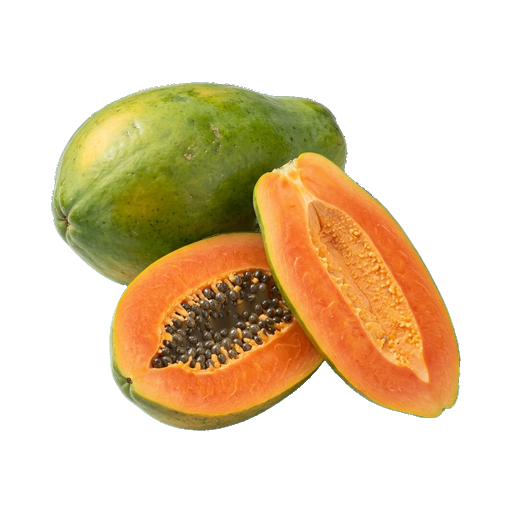
A sweet tropical fruit with soft orange flesh and a distinctive floral-honey aroma. When ripe, papaya has a tender texture slightly reminiscent of melon, and is used in desserts, smoothies, fruit salads, and as a garnish for spicy dishes. When selecting, look for an even yellow-orange color and slight softness when pressed. Unripe papaya can be used in spicy salads like som tam instead of mango.
Micronutrients
per 100 g
Minerals
About
Aroma and Flavor
Papaya is a fruit easily recognized by its delicate orange flesh and sweet, slightly herbaceous flavor. Ripe papaya has a delicate aroma, almost floral, with a hint of melon. The taste depends on the degree of ripeness: underripe papaya is more neutral and slightly astringent, while ripe papaya becomes sweet and almost honey-like. The texture of the flesh is soft, almost buttery, with many black seeds inside that you can either leave or remove — it's a matter of taste.
Papaya's main feature is the presence of the papain enzyme. This substance makes the fruit not only delicious but also beneficial for digestion. Thanks to this enzyme, papaya works wonderfully in meat marinades, tenderizing the fibers, and helps the body digest heavy food. The seeds are also edible and have a sharp, mustard-like flavor — they are added to salads or used as a seasoning.
Role in Dishes
Fresh papaya is eaten with a spoon straight from the half, added to fruit salads and smoothies. The flesh pairs well with lime, lemon, and ginger — this combination highlights the natural sweetness of the fruit. Papaya is cut into cubes and served as an appetizer with spicy dishes, where its softness and sweetness balance the heat of the spices.
In cooking, papaya works as a marinade: mashed pulp or several slices of fruit are added to meat for several hours, and it becomes more tender. Unripe papaya is used as a vegetable — it is stewed, fried, and added to curries. Ripe papaya is used to make jams, mousse, and fruit jellies. It is excellent in sauces for fish and seafood, including sweet and sour Asian sauces.
Selection and Storage
Ripe papaya yields to gentle finger pressure but doesn't become mushy. The skin should be yellow-orange without any green spots. If the fruit is too firm, it can be left at room temperature for a few days to ripen. Ripe papaya is best eaten within a day or two, otherwise it will start to spoil. In the refrigerator, ripe papaya can be stored for 3–5 days in a bag to prevent it from absorbing odors from other foods.
Preparing papaya is simple: cut it in half lengthwise, remove the seeds with a spoon, and cut the flesh into cubes or slices. If you need peeled papaya, remove the skin with a vegetable peeler or knife. Unripe papaya is cleaned the same way, but cut into strips for stewing or added as whole pieces to dishes where it will soften over heat.
Nutrition
per 100 g
- Calories
- 43 kcal
- Protein
- 0.5 g
- Fat
- 0.3 g
- Carbs
- 10.8 g
Micronutrients
per 100 g
Macronutrients
- Fiber
- 1.7 g
- Sugars
- 7.82 g
- Saturated fat
- 0.081 g
- Monounsaturated fat
- 0.072 g
- Polyunsaturated fat
- 0.058 g
- Omega-3 (EPA + DHA)
- 0 g
- Cholesterol
- 0 mg
- Water
- 88.06 g
Minerals
- Sodium
- 8 mg
- Potassium
- 182 mg
- Calcium
- 20 mg
- Magnesium
- 21 mg
- Phosphorus
- 10 mg
- Iron
- 0.25 mg
- Zinc
- 0.08 mg
- Copper
- 0.05 mg
- Manganese
- 0.04 mg
- Selenium
- 0.6 mcg
Vitamins
- Vitamin A (RAE)
- 47 mcg
- Vitamin D
- 0 mcg
- Vitamin E
- 0.3 mg
- Vitamin K
- 2.6 mcg
- Vitamin C
- 60.9 mg
- Vitamin B1 (thiamin)
- 0.02 mg
- Vitamin B2 (riboflavin)
- 0.03 mg
- Vitamin B3 (niacin)
- 0.36 mg
- Vitamin B5 (pantothenic acid)
- 0.19 mg
- Vitamin B6
- 0.04 mg
- Vitamin B9 (folate, DFE)
- 37 mcg
- Vitamin B12
- 0 mcg
Measures and weight
- 1 pcs
- 300 g
Measure calculator
- Weight
- 100 g
- Calories
- 43 kcal