Usuba
Usuba
Sturgeon
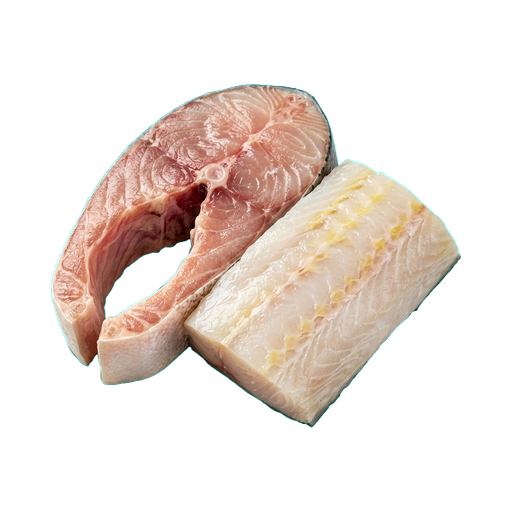
Sturgeon meat is the flesh of sturgeon, a prized delicacy fish with a dense, slightly oily texture and a delicate, refined flavor. The fish contains few bones thanks to its cartilaginous skeleton, which makes processing easier and allows it to be prepared using various cooking methods. When selecting sturgeon, pay attention to the firmness of the meat and the absence of off-odors. If substituting, you can use more affordable varieties of white fish with dense meat, though the flavor qualities will be noticeably more modest.
Micronutrients
per 100 g
Minerals
Vitamins
- AVitamin A (RAE)210mcg25% DV
- DVitamin D10.3mcg69% DV
- EVitamin E0.5mg3% DV
- KVitamin K0.1mcg0% DV
- B1Vitamin B1 (thiamin)0.07mg5% DV
- B2Vitamin B2 (riboflavin)0.07mg4% DV
- B3Vitamin B3 (niacin)8.3mg42% DV
- B5Vitamin B5 (pantothenic acid)0.75mg15% DV
- B6Vitamin B60.2mg10% DV
- B9Vitamin B9 (folate, DFE)15mcg4% DV
- B12Vitamin B122.2mcg73% DV
About
Sturgeon is the meat of a sturgeon, one of the most valuable fish. It is prized for its tender texture, delicate flavor, and versatility in the kitchen. It is not just an ingredient, but an investment in the quality of a dish that requires respectful handling and minimal processing.
Taste and texture
Sturgeon meat is light, almost white, with a subtle, barely perceptible fish aroma. The taste is delicate and slightly sweet, without harshness. The texture is dense but not coarse — the fibers are fine, the meat cuts easily and melts on your tongue. The fat content is moderate, which makes sturgeon ideal for people sensitive to fish flavor.
The peculiarity of sturgeon is that it doesn't smell like "fish" in the conventional sense. It has a delicate, almost neutral flavor with a slight sweetness — which is why this fish is suitable even for those who usually avoid seafood.
How to Cook Sturgeon
Sturgeon is good because it doesn't require complex manipulations. Its delicate flavor is easily overpowered by aggressive spices, so it's better to stick to minimalism.
- On the grill or in the oven — just salt, fresh lemon, and olive oil. The steak cooks for 10–15 minutes at 180–200 °C.
- In a pan — place the fillet skin-side down, fry for 3–4 minutes, then flip and cook until done for another 2–3 minutes.
- Steamed — one of the best ways to preserve tenderness. The meat cooks for 8–12 minutes depending on thickness.
- In soups and broths — sturgeon gives a light, clear broth. The bones are used for stock, and the meat is added at the end of cooking.
Main rule: do not overcook. Sturgeon loses its tenderness with prolonged heat treatment. The meat should remain moist and slightly translucent in the center — this is a sign of perfect doneness.
Pairings and side dishes
Sturgeon works well with light, fresh ingredients. Citrus (lemon, lime) emphasizes its delicacy, herbs (dill, parsley, tarragon) add freshness, and creamy sauces based on white wine bring elegance.
- Side dishes: new potatoes, asparagus, zucchini, mixed salad greens
- Sauces: hollandaise, lemon butter, white wine sauce, champagne reduction
- Spices: white pepper, sea salt, fresh dill, tarragon
- Avoid: hot spices, tomatoes, heavy cream sauces — they overpower the delicate flavor
Selection and Storage
When purchasing, pay attention to the color of the meat — it should be light, almost white, without any yellowish tint. The smell should be barely noticeable, pleasant, and briny. If you detect a strong "fishy" smell, this is a sign of spoilage. The meat should not be sticky or too soft.
It's best to use sturgeon on the day of purchase or, at most, the next day. Wrap it in parchment paper (not plastic) and store it on the coldest shelf of your refrigerator. Frozen meat maintains its quality for up to 3 months, but thaw it slowly in the refrigerator to avoid losing moisture.
Sturgeon is a fish for those who appreciate quality and simplicity. It doesn't require masking or complex techniques, only honest and careful preparation. A few minutes in a pan, a pinch of salt and good lemon — that's all it takes to appreciate its true taste.
Nutrition
per 100 g
- Calories
- 163 kcal
- Protein
- 18.2 g
- Fat
- 9.3 g
- Carbs
- 0 g
Micronutrients
per 100 g
Macronutrients
- Fiber
- 0 g
- Sugars
- 0 g
- Saturated fat
- 0.915 g
- Monounsaturated fat
- 1.939 g
- Polyunsaturated fat
- 0.69 g
- Omega-3 (EPA + DHA)
- 0.287 g
- Cholesterol
- 60 mg
- Water
- 76.55 g
Minerals
- Sodium
- 54 mg
- Potassium
- 284 mg
- Calcium
- 13 mg
- Magnesium
- 35 mg
- Phosphorus
- 211 mg
- Iron
- 0.7 mg
- Zinc
- 0.42 mg
- Copper
- 0.04 mg
- Manganese
- 0.03 mg
- Selenium
- 12.6 mcg
Vitamins
- Vitamin A (RAE)
- 210 mcg
- Vitamin D
- 10.3 mcg
- Vitamin E
- 0.5 mg
- Vitamin K
- 0.1 mcg
- Vitamin C
- 0 mg
- Vitamin B1 (thiamin)
- 0.07 mg
- Vitamin B2 (riboflavin)
- 0.07 mg
- Vitamin B3 (niacin)
- 8.3 mg
- Vitamin B5 (pantothenic acid)
- 0.75 mg
- Vitamin B6
- 0.2 mg
- Vitamin B9 (folate, DFE)
- 15 mcg
- Vitamin B12
- 2.2 mcg
Measures and weight
- 1 pcs
- 1500 g
Measure calculator
- Weight
- 100 g
- Calories
- 163 kcal