Usuba
Usuba
Blue cheese
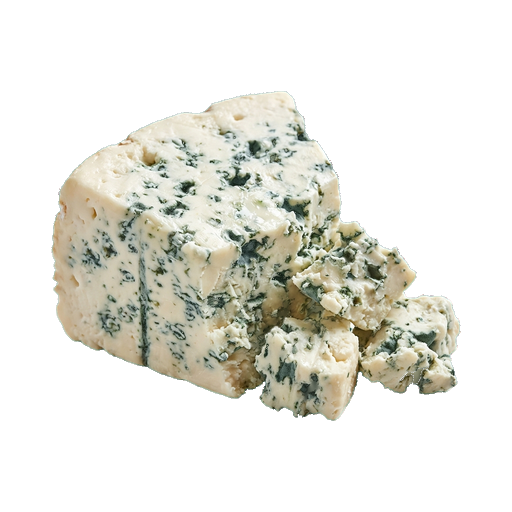
Blue cheese is a soft cheese characterized by distinctive veins of blue, green, or white mold that give it a sharp, slightly bitter taste and intense aroma. The mold is distributed throughout the cheese mass, making its texture crumbly and easy to break apart. This cheese works well for appetizers, salads, sauces, and desserts, but requires caution when substituting for regular cheese, as its flavor is much more pronounced and can overpower delicate dishes.
Micronutrients
per 100 g
Minerals
Vitamins
- AVitamin A (RAE)198mcg23% DV
- DVitamin D0.5mcg3% DV
- EVitamin E0.25mg2% DV
- KVitamin K2.4mcg2% DV
- B1Vitamin B1 (thiamin)0.03mg2% DV
- B2Vitamin B2 (riboflavin)0.38mg21% DV
- B3Vitamin B3 (niacin)1.02mg5% DV
- B5Vitamin B5 (pantothenic acid)1.73mg35% DV
- B6Vitamin B60.17mg9% DV
- B9Vitamin B9 (folate, DFE)36mcg9% DV
- B12Vitamin B121.2mcg40% DV
About
Aroma and Taste
Blue cheese is not a spoiled product, but the result of a controlled ripening process. The mold that permeates the cheese creates a characteristic sharp, slightly bitter taste with nutty and earthy notes. The smell can be intense and pungent, especially if the cheese has been left at room temperature for a long time, but this is normal — it is a sign of rich flavor, not spoilage.
The texture of such cheeses is usually soft, almost creamy, with blue or greenish veins of mold. When pressed, the cheese yields slightly but should not be sticky. The longer the cheese matures, the more saturated its flavor becomes and the more crumbly its texture.
Role in dishes
Blue cheese is a star of charcuterie boards, but its place is not limited to there. A few crumbles on a pear or apple salad will create a sharp contrast with the sweetness of the fruit. It works well in sauces for steak or in pasta, where its pungency balances the richness of cream. On bread with butter or honey—a classic pairing that reveals all the nuances of flavor.
Main rule: use blue cheese sparingly. Its intense flavor can easily overpower other components of the dish. Even a small amount can significantly change the character of an appetizer or salad.
Successful Pairings
- Pear, apple, fig — fruits with delicate sweetness emphasize the sharpness of cheese
- Walnuts, almonds — nutty notes enhance the complexity of flavor
- Honey and jam — sweetness creates contrast with salt and spiciness
- Red wine, port — acidity and tannins balance the intensity
- Dark bread, seeded bread — coarse texture complements the creamy consistency
How to Choose and Store
When selecting, pay attention to the even distribution of mold — it should be visible throughout the cheese. Avoid cheese with excessively softened edges or dark spots that look like discoloration rather than natural mold. The cheese should smell pungent, but not of ammonia — this is a sign of over-ripening.
Store blue cheese in the refrigerator in an airtight container or wrapped in parchment paper, not in plastic — mold needs a slight air circulation. Keep it separate from other products so its smell doesn't transfer to neighboring ingredients. With proper storage, cheese will last 2–3 weeks. Before serving, take it out of the refrigerator 15–20 minutes in advance — at room temperature, the flavor will develop more fully.
Blue cheese demands respect for its character. There's no need to mask it — it's better to highlight its sharpness with the right pairing.
Nutrition
per 100 g
- Calories
- 350 kcal
- Protein
- 20 g
- Fat
- 29 g
- Carbs
- 2 g
Micronutrients
per 100 g
Macronutrients
- Fiber
- 0 g
- Sugars
- 0.5 g
- Saturated fat
- 18.669 g
- Monounsaturated fat
- 7.778 g
- Polyunsaturated fat
- 0.8 g
- Omega-3 (EPA + DHA)
- 0 g
- Cholesterol
- 75 mg
- Water
- 42.41 g
Minerals
- Sodium
- 1146 mg
- Potassium
- 256 mg
- Calcium
- 528 mg
- Magnesium
- 23 mg
- Phosphorus
- 387 mg
- Iron
- 0.31 mg
- Zinc
- 2.66 mg
- Copper
- 0.04 mg
- Manganese
- 0.01 mg
- Selenium
- 14.5 mcg
Vitamins
- Vitamin A (RAE)
- 198 mcg
- Vitamin D
- 0.5 mcg
- Vitamin E
- 0.25 mg
- Vitamin K
- 2.4 mcg
- Vitamin C
- 0 mg
- Vitamin B1 (thiamin)
- 0.03 mg
- Vitamin B2 (riboflavin)
- 0.38 mg
- Vitamin B3 (niacin)
- 1.02 mg
- Vitamin B5 (pantothenic acid)
- 1.73 mg
- Vitamin B6
- 0.17 mg
- Vitamin B9 (folate, DFE)
- 36 mcg
- Vitamin B12
- 1.2 mcg
Measures and weight
- 1 slice
- 20 g
Measure calculator
- Weight
- 100 g
- Calories
- 350 kcal