Usuba
Usuba
Watercress
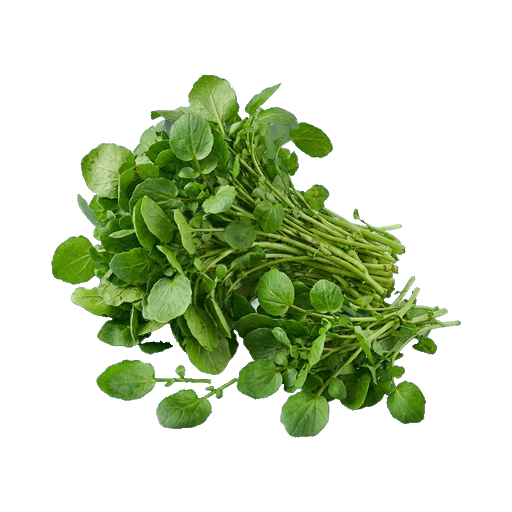
Watercress is tender greens with a sharp, slightly bitter taste and a distinctive peppery aroma. The plant's leaves contain a lot of moisture, so they wilt quickly and require storage in the refrigerator in a humid environment. In cooking, watercress is used in salads, soups, and as a garnish for fish and meat, adding it at the end of cooking to preserve freshness and crunchiness.
Micronutrients
per 100 g
Minerals
About
Watercress is a leafy green that grows in water and catches the attention of chefs with its sharp, slightly bitter taste. Small dark green leaves on thin stems look delicate, but work seriously on the plate: they add depth and piquancy where a fresh note is needed.
Taste and Aroma
Watercress has a characteristic sharpness similar to radish or mustard, but milder and more delicate. The taste is fresh, slightly spicy, with a barely perceptible bitterness that disappears with heat treatment. The aroma is herbaceous, clean, without any extraneous notes.
Where to use
Watercress is versatile. Raw, it adorns salads, sandwiches, and appetizers, adding piquancy and texture. You can add it to soup a minute before serving — it will retain its bright flavor and won't fall apart. Try adding it to mashed potatoes or cauliflower to refresh the dish with a sharp note.
Successful Pairings
- Fish and seafood — watercress emphasizes their tenderness and removes heaviness
- Oil and creamy sauces — watercress pungency balances the richness of fat
- Eggs — in omelets and for breakfast watercress adds vitality
- Lemon and vinegar — acidity enhances the piquancy of watercress
- Potatoes and root vegetables — contrast of flavors makes the dish more interesting
Selection and Storage
When buying, pay attention to the bright green color of the leaves and the firmness of the stems. Wilted, yellow, or slimy greens are a sign that the watercress has lost its freshness. Store it in the refrigerator in a container or on a damp cloth, wrapped in a bag. This way it will last 3–4 days. Before using, rinse under cold water and dry.
Practical Tips
- Add watercress at the end of cooking to preserve its sharp taste and crispy texture
- For salads, use young leaves — they are more tender and less bitter
- If watercress seems too sharp, soak it for 10 minutes in cold water
- The stems are also edible — don't discard them, add them to soups and purees
Watercress is not just a garnish, but an active ingredient that changes the flavor profile of a dish. Its pungency is respected by chefs who appreciate vibrant, fresh flavors and are willing to work with bold contrasts.
Nutrition
per 100 g
- Calories
- 11 kcal
- Protein
- 2.3 g
- Fat
- 0.1 g
- Carbs
- 1.3 g
Micronutrients
per 100 g
Macronutrients
- Fiber
- 0.5 g
- Sugars
- 0.2 g
- Saturated fat
- 0.027 g
- Monounsaturated fat
- 0.008 g
- Polyunsaturated fat
- 0.035 g
- Omega-3 (EPA + DHA)
- 0 g
- Cholesterol
- 0 mg
- Water
- 95.11 g
Minerals
- Sodium
- 41 mg
- Potassium
- 330 mg
- Calcium
- 120 mg
- Magnesium
- 21 mg
- Phosphorus
- 60 mg
- Iron
- 0.2 mg
- Zinc
- 0.11 mg
- Copper
- 0.08 mg
- Manganese
- 0.24 mg
- Selenium
- 0.9 mcg
Vitamins
- Vitamin A (RAE)
- 160 mcg
- Vitamin D
- 0 mcg
- Vitamin E
- 1 mg
- Vitamin K
- 250 mcg
- Vitamin C
- 43 mg
- Vitamin B1 (thiamin)
- 0.09 mg
- Vitamin B2 (riboflavin)
- 0.12 mg
- Vitamin B3 (niacin)
- 0.2 mg
- Vitamin B5 (pantothenic acid)
- 0.31 mg
- Vitamin B6
- 0.13 mg
- Vitamin B9 (folate, DFE)
- 9 mcg
- Vitamin B12
- 0 mcg
Measures and weight
- 1 tbsp
- 4.5 g
- 1 tsp
- 1.5 g
- 1 cup
- 75 g
- 1 bunch
- 100 g
Measure calculator
- Weight
- 100 g
- Calories
- 11 kcal