Usuba
Usuba
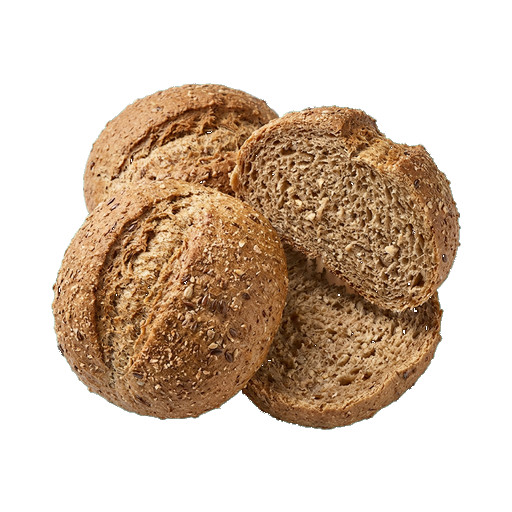
Whole wheat bun
A rich bun with a dense, slightly crumbly texture, made from whole grain or unbleached flour that retains the bran and wheat germ. Such buns have a more pronounced nutty and slightly bitter taste compared to white flour buns, as well as higher fiber and nutrient content. When using in recipes, keep in mind that unbleached flour absorbs more liquid, so you may need to increase the amount of milk or water in the dough.
Micronutrients
per 100 g
Minerals
Vitamins
- AVitamin A (RAE)33mcg4% DV
- EVitamin E0.41mg3% DV
- KVitamin K4.5mcg4% DV
- CVitamin C1.3mg1% DV
- B1Vitamin B1 (thiamin)0.44mg29% DV
- B2Vitamin B2 (riboflavin)0.19mg11% DV
- B3Vitamin B3 (niacin)4.52mg23% DV
- B5Vitamin B5 (pantothenic acid)0.84mg17% DV
- B6Vitamin B60.19mg10% DV
- B9Vitamin B9 (folate, DFE)42mcg11% DV
- B12Vitamin B120.2mcg7% DV
About
A whole wheat bun is not just a baked good, but practically a universal component for baking and sweet dishes. Its main distinction is that the flour is not sifted before mixing, which means all particles of bran and grain germ remain in the dough. This affects not only the taste and texture, but also how the bun behaves in the dough when you crumble it or soak it.
Taste and Texture
This bun has a more pronounced, slightly nutty flavor due to the bran. The texture is denser and drier than a white flour bun — it crumbles more readily, which is ideal for breading or for soaking in liquid. The color is brownish or grayish-brown, and the surface is often rougher.
Where to use it
Whole wheat bun works in several ways. It is crumbled for breading cutlets, fish, or vegetables — a crispy crust is achieved thanks to its dense structure. It is soaked in milk or broth for fillings, pâtés, and casseroles. It is used as part of fillings for pies and pastries. Some cooks add it to dough for buns and bread to make the texture more interesting.
- Breading for frying meat and fish
- Soaking in liquid for minced meat and pâtés
- Additive to baking dough
- Component of pie fillings
- Base for homemade breadcrumbs
Selection and Storage
When choosing, make sure the bun is dry and has no signs of mold. A slightly stale bun is even better — it crumbles more easily. If the bun is very fresh and soft, let it sit for a day or two at room temperature, and it will become easier to work with.
Store the bun in a dry place in a paper bag or cloth sack — plastic creates moisture and the bun may become moldy. At room temperature, it keeps for 1–2 weeks. For longer storage, you can dry the bun completely and grind it into breadcrumbs, which will last for months.
Whole wheat roll is a practical ingredient that will always come in handy in the kitchen. It is valued for its reliability: it doesn't get soggy in breadcrumbs, holds its shape well in ground meat, and adds a subtle grainy texture to dishes. If you cook often, it makes sense to always keep a couple of rolls on hand.
Nutrition
per 100 g
- Calories
- 280 kcal
- Protein
- 9.5 g
- Fat
- 4 g
- Carbs
- 50 g
Micronutrients
per 100 g
Macronutrients
- Fiber
- 6.1 g
- Sugars
- 5.92 g
- Saturated fat
- 0.921 g
- Monounsaturated fat
- 0.717 g
- Polyunsaturated fat
- 1.776 g
- Omega-3 (EPA + DHA)
- 0 g
- Cholesterol
- 0 mg
- Water
- 35.92 g
Minerals
- Sodium
- 477 mg
- Potassium
- 242 mg
- Calcium
- 198 mg
- Magnesium
- 81 mg
- Phosphorus
- 217 mg
- Iron
- 2.42 mg
- Zinc
- 1.71 mg
- Copper
- 0.24 mg
- Manganese
- 2.31 mg
- Selenium
- 32.9 mcg
Vitamins
- Vitamin A (RAE)
- 33 mcg
- Vitamin D
- 0 mcg
- Vitamin E
- 0.41 mg
- Vitamin K
- 4.5 mcg
- Vitamin C
- 1.3 mg
- Vitamin B1 (thiamin)
- 0.44 mg
- Vitamin B2 (riboflavin)
- 0.19 mg
- Vitamin B3 (niacin)
- 4.52 mg
- Vitamin B5 (pantothenic acid)
- 0.84 mg
- Vitamin B6
- 0.19 mg
- Vitamin B9 (folate, DFE)
- 42 mcg
- Vitamin B12
- 0.2 mcg
Measures and weight
- 1 pcs
- 60 g
Measure calculator
- Weight
- 100 g
- Calories
- 280 kcal