Usuba
Usuba
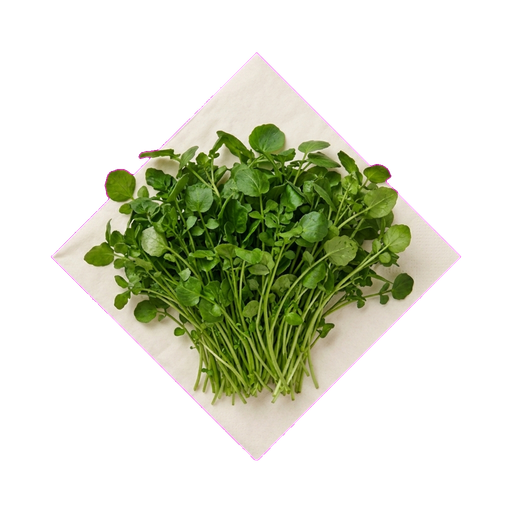
Watercress
Watercress is delicate greens with thin stems and small rounded leaves, characterized by a slightly sharp, piquant flavor with peppery notes. It is mainly used as a garnish or addition to salads, sandwiches, and cold appetizers thanks to its fresh appearance and spicy taste. When selecting, pay attention to the firmness of the leaves and bright green color — wilted greens quickly lose their characteristic sharpness and become bitter.
Micronutrients
per 100 g
Minerals
About
Watercress is a peppery green with thin stems and small rounded leaves that appears on the table when you want to add piquancy to familiar dishes. Its taste is piercing, mustard-like, with a barely perceptible sweetness. The leaves are crispy, and the aftertaste lingers for a long time — which is precisely why watercress is used in pinches rather than by the kilogram.
Aroma and Spice
The mustard sharpness of watercress is reminiscent of radish, but milder and more delicate. When you bite a leaf, you first feel freshness, then a slight burning sensation on your tongue. This happens thanks to essential oils, which give the greens their characteristic pungent aroma. Young watercress is more tender, while mature watercress has a more pronounced flavor.
Where to use it
- Sandwiches and canapés — watercress adds pungency and texture, pairs well with soft cheese, butter, and smoked fish
- Salads — works as a sharp accent among soft leaves and vegetables, doesn't require large quantities
- Soups — sprinkle watercress into the bowl right before serving to preserve crunch and freshness
- Fish and meat dishes — watercress pungency highlights the taste of fatty meat and tender fish
- Scrambled eggs and omelets — watercress adds a piquant touch to simple breakfasts
Combinations and Proportions
Watercress pairs well with neutral ingredients that don't compete with its pungency. Butter, cream cheese, avocado, boiled egg — all of these soften its sharpness and create balance. Lemon juice or vinegar enhance the mustard notes. Watercress should not be mixed with hot spices, otherwise the dish will become too aggressive in taste. A handful of watercress is enough to transform a dish for two or three people.
Selection and Storage
- Look for bright greens without yellowing and wilting — this is a sign of freshness
- Leaves should be firm and crispy, stems — not wilted
- The smell should be sharp and fresh, without mustiness
Watercress wilts quickly and loses its freshness, so buy it shortly before use. Store it in the refrigerator in a plastic container or wrapped in damp cloth — this way it will last three to four days. If watercress starts to dry out, place it in cold water for a few hours, and it will regain its crispness. Freezing watercress is not recommended — after thawing it will become soft and lose its crunch.
Watercress is not a main ingredient, but a final touch. Add it at the end of cooking or just before serving to preserve its pungency and freshness.
Nutrition
per 100 g
- Calories
- 32 kcal
- Protein
- 2.6 g
- Fat
- 0.7 g
- Carbs
- 5.5 g
Micronutrients
per 100 g
Macronutrients
- Fiber
- 0.5 g
- Sugars
- 0.2 g
- Saturated fat
- 0.027 g
- Monounsaturated fat
- 0.008 g
- Polyunsaturated fat
- 0.035 g
- Omega-3 (EPA + DHA)
- 0 g
- Cholesterol
- 0 mg
- Water
- 95.11 g
Minerals
- Sodium
- 41 mg
- Potassium
- 330 mg
- Calcium
- 120 mg
- Magnesium
- 21 mg
- Phosphorus
- 60 mg
- Iron
- 0.2 mg
- Zinc
- 0.11 mg
- Copper
- 0.08 mg
- Manganese
- 0.24 mg
- Selenium
- 0.9 mcg
Vitamins
- Vitamin A (RAE)
- 160 mcg
- Vitamin D
- 0 mcg
- Vitamin E
- 1 mg
- Vitamin K
- 250 mcg
- Vitamin C
- 43 mg
- Vitamin B1 (thiamin)
- 0.09 mg
- Vitamin B2 (riboflavin)
- 0.12 mg
- Vitamin B3 (niacin)
- 0.2 mg
- Vitamin B5 (pantothenic acid)
- 0.31 mg
- Vitamin B6
- 0.13 mg
- Vitamin B9 (folate, DFE)
- 9 mcg
- Vitamin B12
- 0 mcg
Measures and weight
- 1 bunch
- 50 g
- 1 sprig
- 3 g
Measure calculator
- Weight
- 100 g
- Calories
- 32 kcal