Usuba
Usuba
Vegetable oil
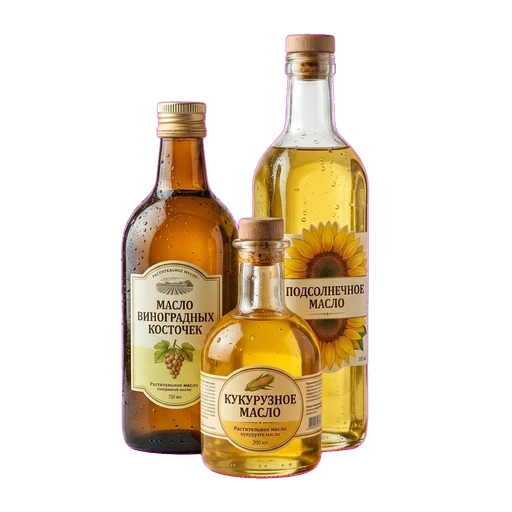
Vegetable oil is a liquid fat extracted from seeds or fruits of plants, the primary ingredient for frying, dressing salads, and making sauces. Based on processing type, oils are divided into refined (odorless, with stable smoke point) and unrefined (with pronounced flavor and aroma, more sensitive to heat). When choosing, consider the purpose: refined oil with a high smoke point is suitable for frying, while unrefined oil with characteristic flavor works best for dressings and sauces.
Micronutrients
per 100 ml
Minerals
About
Vegetable oil is one of the most versatile ingredients in the kitchen. It is not just a fat for frying, but a full-fledged flavor and technological component that changes a dish depending on the variety and method of use. The choice of oil affects the result just as strongly as the choice of flour for bread or milk for cheese.
Aroma and taste: from neutral to pronounced
This is where the main difference begins. Refined oils are virtually odorless — they are ideal when you don't want the oil to compete with the main ingredients. Unrefined oils, on the other hand, are generous with aroma: sunflower gives a nutty note, flaxseed — herbaceous, sesame — a deep, almost smoky smell.
Smoke point is a practical parameter that is often overlooked. Refined oils handle high temperatures well and are suitable for frying and deep frying. Unrefined oils are more finicky: they are better used for dressings, sauces, and added to finished dishes to preserve their aroma.
Role in different dishes
In dough, butter acts as a structure-builder: it makes baked goods fluffy or, conversely, flaky depending on the kneading technique. In salads and cold appetizers, unrefined oil becomes the hero — its flavor enhances tomatoes, vegetables, and herbs. In a pan, oil is a heat conductor, but also a taste participant: it absorbs the aroma of spices and garlic, creating the base for a sauce.
- For frying and deep frying — refined oil with a high smoke point
- For dressings and sauces — unrefined oil with pronounced flavor
- For baking — neutral oil to avoid overpowering other ingredients
- For finishing prepared dishes — aromatic unrefined oil
Selection and Storage
When choosing, pay attention to the color and transparency. Refined oil is light and clear. Unrefined oil may be slightly cloudy — this is normal and even a good sign, indicating preserved beneficial substances. The smell should be pleasant, without bitterness or mustiness.
It is best to store oil in a cool place, protected from light. Refined oil is more stable and can last longer. Unrefined oil can become bitter over time, especially if the bottle is frequently opened and the oil is exposed to oxygen. Some oils may become cloudy in the refrigerator — this is not spoilage, but a natural process; at room temperature, transparency will return.
Vegetable oil is not just a technical ingredient. It is a tool that, in the hands of a chef, can emphasize the flavor of a dish or remain an invisible helper. It makes sense to keep several types in your kitchen: one for cooking, another for flavor.
Nutrition
per 100 ml
- Calories
- 884 kcal
- Protein
- 0 g
- Fat
- 99.9 g
- Carbs
- 0 g
Micronutrients
per 100 ml
Macronutrients
- Fiber
- 0 g
- Sugars
- 0 g
- Saturated fat
- 16.45 g
- Monounsaturated fat
- 19.108 g
- Polyunsaturated fat
- 10.258 g
- Omega-3 (EPA + DHA)
- 0 g
- Cholesterol
- 49.68 mg
- Water
- 41.124 g
Minerals
- Sodium
- 534.52 mg
- Potassium
- 5.52 mg
- Calcium
- 5.52 mg
- Magnesium
- 0 mg
- Phosphorus
- 9.2 mg
- Iron
- 0.04 mg
- Zinc
- 0.01 mg
- Copper
- 0 mg
- Selenium
- 0.5 mcg
Vitamins
- Vitamin A (RAE)
- 753.5 mcg
- Vitamin D
- 0 mcg
- Vitamin E
- 8.46 mg
- Vitamin K
- 56.2 mcg
- Vitamin C
- 0 mg
- Vitamin B1 (thiamin)
- 0 mg
- Vitamin B2 (riboflavin)
- 0.01 mg
- Vitamin B3 (niacin)
- 0.01 mg
- Vitamin B6
- 0 mg
- Vitamin B9 (folate, DFE)
- 0.9 mcg
- Vitamin B12
- 0 mcg
Measures and weight
- 1 tbsp
- 13.8 g
- 1 tsp
- 4.6 g
- 1 cup
- 230 g
Measure calculator
- Weight
- 100 g
- Calories
- 961 kcal